I love hair and unique looks so I'm gonna share some from around the world.



The West Indies
Rastafarian Dreadlocks often come to mind when mentioning the West Indies. The reason I added the white lady with the locs is to show that not only do they where locs as a culture in the West Indies(particularly Jamaica) they also where them as a fashion statement around the world as well.


Polynesia/ Melanesia- I wanted to post them together to show the diversity in the South Pacific.


Japan
Taregami
The taregami hair
was a product of the Heian period. According to the British Museum,
this period marked the rise of courtly culture centered around nobility
and the end of Chinese influence on Japanese culture. The Japanese
noblewomen began wearing their hair as long as possible without binding
it. Long, flowing hair was considered the height of Japanese beauty
during this time because noblewomen were expected to remain sedentary
most of the time. The novel "The Tale of Genji," written by a Japanese
noblewoman named Murasaki Shikibu, describes women wearing the taregami
hairstyle.
Chonmage
With the decline of the Heian court came the rise of the
samurai military class, who took over Japanese culture. The Kamakura,
Muromachi and Sengoku periods, or height of the samurai class from 1194
to 1600, saw simpler and more practical hairstyles.
The distinctive hairstyle of the samurai was the chonmage, or topknot.
Several varieties of chonmage existed, ranging from the simple
Chinese-inspired ponytail half-loop topknot to the mitsu-ori, or a
topknot folded forward onto the head. The mitsu-ori was popular during
the late 16th century. In the 21st century, the only common wearers of
the chonmage are sumo wrestlers.
Shimada
With the unification of Japan in the early 1600s came the
rise of civilian culture. One of the most distinctive cultural figures
of the Edo period was the geisha, or hired entertainer/artist. All
geisha wore their hair in one of several hairstyles collectively called
shimada. The most commonly seen hairstyle is known as the momoware, or
split peach, and is worn by apprentice geisha known as maiko, according
to Beauty and the Bath. The momoware is a high bun that splits in two
along the middle.


Brazil
I would like to have more to say about Brazil and traditional style, However I Chose to post the women with the tignons. Made me think of Carmen Miranda- MAMÃE EU QUERO.
It was the mandatory head-wear for Creole women in Louisiana during the
Spanish colonial period, and the style was adopted throughout the
Caribbean island communities as well. This headdress was required by
Louisiana laws in 1785. Called the tignon laws, they prescribed
appropriate public dress for females of color in colonial society, where
some women of color & some white women tried to outdo each other in
beauty, dress, ostentation and manners.
In an effort to maintain class distinctions in his Spanish colony at the beginning of his term, Governor Esteban Rodriguez Miró (1785 - 1791) decreed that women of color, slave or free, should cover their heads with a knotted headdress and refrain from "excessive attention to dress."
In an effort to maintain class distinctions in his Spanish colony at the beginning of his term, Governor Esteban Rodriguez Miró (1785 - 1791) decreed that women of color, slave or free, should cover their heads with a knotted headdress and refrain from "excessive attention to dress."


Panama
The traditional women's
costume of Panama, the "pollera," would be incomplete without the
intricately decorative hairstyle. There are three types of pollera: the
pollera de gala, for special occasions; the pollera montuna, for
everyday wear; and the pollera de boda, or wedding dress. Each of these
traditional costumes is topped with appropriately elaborate hair
ornaments.

France
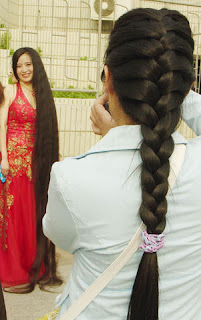
( well the French braid and roll) I liked this picture because if you look at the lady's hair is the back, it touches the ground....wow!!


The West Indies
Rastafarian Dreadlocks often come to mind when mentioning the West Indies. The reason I added the white lady with the locs is to show that not only do they where locs as a culture in the West Indies(particularly Jamaica) they also where them as a fashion statement around the world as well.


Polynesia/ Melanesia- I wanted to post them together to show the diversity in the South Pacific.

India
It always amazes me how dark Indians can be and how straight their hair is.


Australia
Aborigines have beautiful hair, thank God for the hair right? I mean if it wasn't for their hair... well that's all I will say about that lol.

The things we do for health and beauty. It all fascinates me. Someone would call me vain but I am no more vain than someone that goes to the shop faithfully to get their hair and nails done or puts on make up. I call what I do "celebrating beauty" and me addressing the "dos and don'ts"


 Posts

